
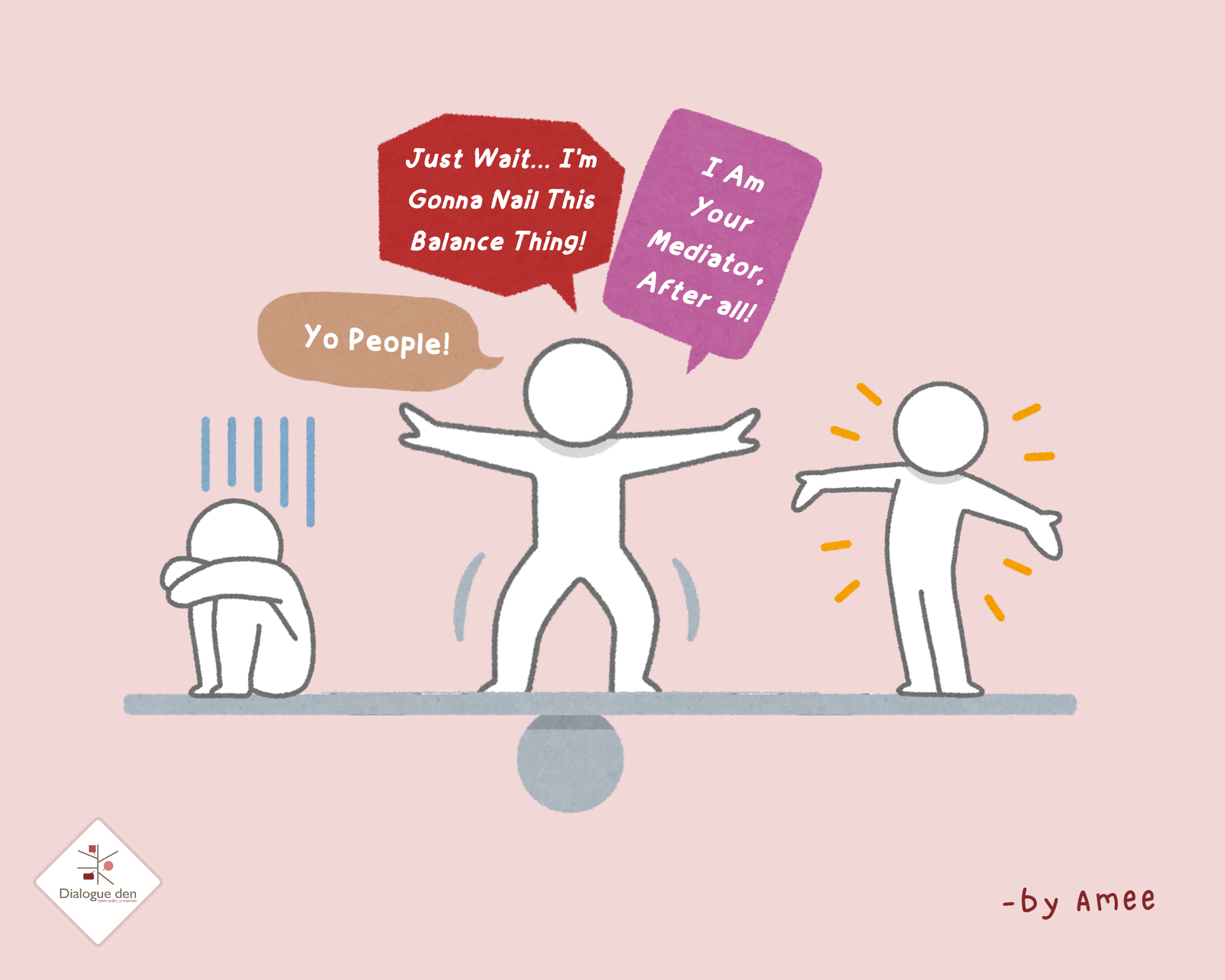
Disclaimer: Dear reader, please allow me to draw parallels between the roles of a mediator and a storywriter, emphasizing the mentality needed for mediation without confusing it with the active role of storywriting. Ok? Promise here to keep an open mind before reading further? Remember, Life is a Poem. Just, let it unfold, even if you miss to get the Po of it.
Ok. so here we go :). I hope you enjoy your read,
It could begin with your question first: What has a mediator to do with a storywriter?
Imagine watching a serial where the characters are intense, embodying stark contrasts of good and bad, right and wrong, with each character holding extreme views. As viewers, it’s almost automatic to take sides, aligning with the characters and situations that resonate with personal beliefs and principles.
But consider this—what if the storywriter also took sides, only writing from the perspective of their preferred characters? There would be no story, yes? How can there be a tale of good without bad, a narrative of right without wrong? The interplay of opposing forces is what makes the story compelling.
If you may allow me, please, with your permission dear reader, I would like to say that there could be a lesson to be learned from this observation. This observation here—– “The interplay of opposing forces is what makes the story compelling.”
In mediation, rather than being like the story-viewer who takes sides, could it be better that we strive to be like the storywriter who understands and integrates all perspectives? When conflicts are brought to the mediation table, it’s tempting to see things through the lens of one party’s narrative. However, like a skilled storywriter, could we balance the interplay of opposing forces, absolutely equally, without even being influenced by personal barriers?
What I am thinking is that… A skilled storywriter explores both perspectives impartially, portraying the complexities of good and bad, right and wrong, from each character’s viewpoint. Similarly, with my attempt to compare it with mediator’s role, I say that, a mediator immerses themselves in the experiences and perspectives of all parties involved. By understanding both sides of the issue, a mediator can guide the parties towards a constructive resolution. But, here, wait! It’s essential to clarify that the mention of “wrong” and “right” words here with reference to mediation, it doesn’t imply one party being entirely right and the other wrong. Instead, the emphasis is on dissecting the situation.
Also, note: While story-writing actively shapes narratives and drives the plot, mediation takes on a more passive role. A mediator doesn’t create the story but facilitates its unfolding, allowing the parties involved to tell their own versions of the tale. The comparison in this writing highlights the mentality mediators could adopt, rather than their literal actions. Mediators, like storywriters, could appreciate and balance all perspectives. It’s about fostering a space where conflicting stories can coexist and eventually intertwine into a harmonious conclusion. Difficult, but not impossible. Yes?
If a mediator only saw one side of the story, it would result in a flat, one-dimensional narrative. Just as a compelling story requires the balance of multiple perspectives, successful mediation thrives on this complexity and balance. When people come to mediation, they are often entrenched in their positions. A mediator’s role, like that of a storywriter, could be to weave a narrative that encompasses all viewpoints, creating a space where all voices are heard.
In embracing this approach (analogy?), mediators could help parties move beyond their entrenched positions to find common ground. The process becomes a journey of understanding, much like how a storywriter crafts a tale that engages readers through its richness and diversity.
Concluding here with my confirming thought that– Just as a storywriter masterfully balances good and bad to create a compelling narrative, mediators must balance all sides of a conflict to help parties craft their own resolution. Because, in the end, every good story—and every successful mediation—thrives on the richness of diverse perspectives. If not, for once, imagine a story like Little Red Riding Hood without the wolf or Akbar without Birbal.

That’s about it. What are you thinking at this moment? Do you have any thoughts you’d like to share with us here in the comments section? It would be nice to hear from you because you and I could be the forces making a balance.
Thank you for your time, and interest :).





Leave a Reply