
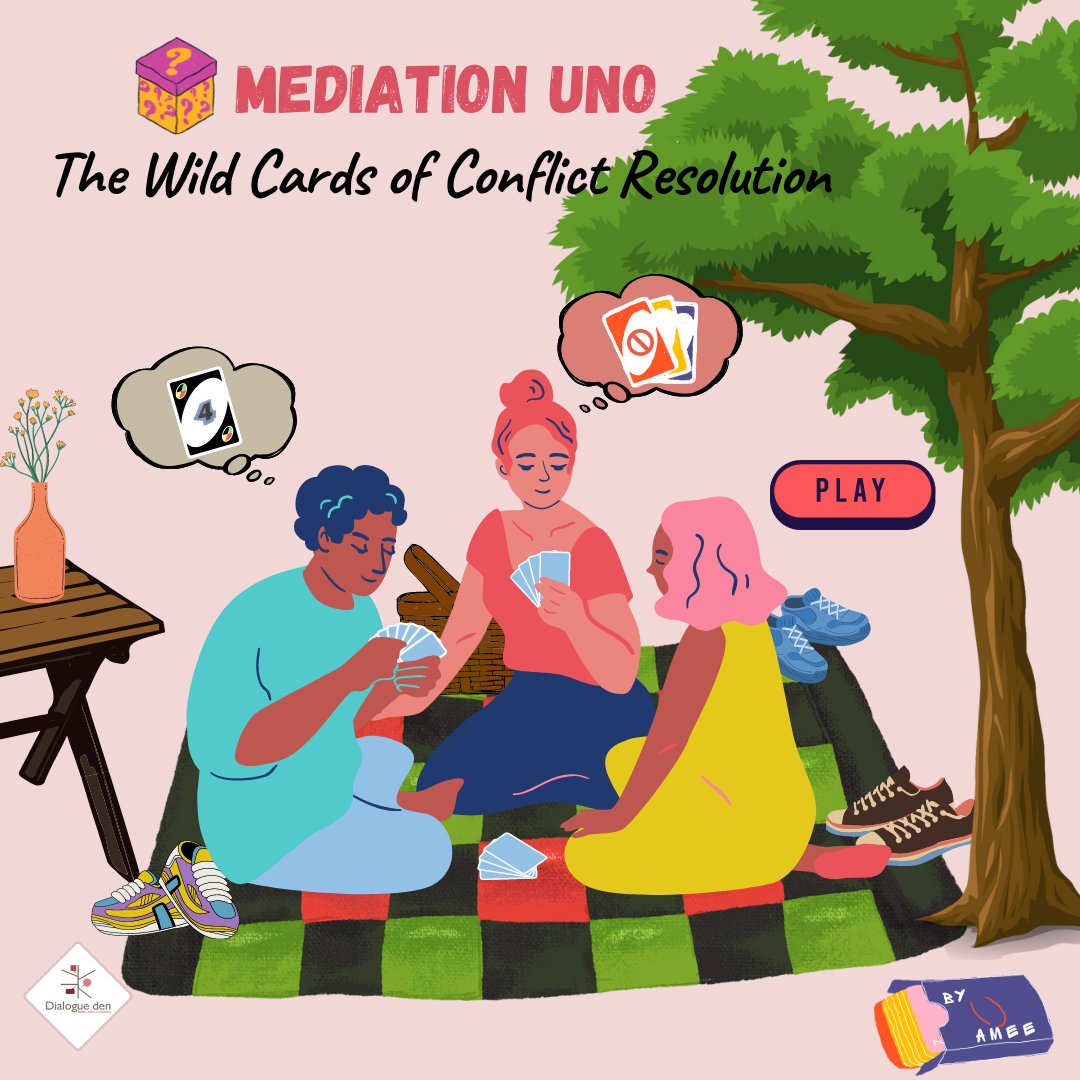
Ah, UNO—the beloved card game that has been the root of many sibling squabbles and household feuds.
Picture this: a family game night that starts off with laughter and fun but soon devolves into chaos as someone slaps down that dreaded “Draw Four” card. Accusations of cheating fly, alliances form and break, and before you know it, the room is filled with cries of “You skipped me again!” and “No, you can’t stack those!” It’s amazing how a simple game of colorful cards can create such intense drama and lasting rivalries. But what about it and Mediation?
It’s one interesting thought! Please join me, let’s read ahead,
Entering mediation can feel like sitting down to play a game of UNO. The parties might not know exactly what to expect, but they’re ready to engage.
Much like the colorful deck of UNO cards, mediation has its own surprises and strategies:
- Reverse: Just when one party thinks they have the floor, a “Reverse” card flips the direction. In mediation, this happens when the discussion suddenly shifts to hear the other party’s perspective. It’s a reminder that things can change direction quickly, and flexibility is key.
- Skip: A “Skip” card can be a playful way to pause someone’s turn, giving the other party a chance to voice their concerns without interruption. In mediation, a well-timed “Skip” can mean addressing one issue at a time, ensuring that each party gets a fair hearing.
- Draw Four: The ultimate game-changer, the “Draw Four” card, can turn the game on its head. In mediation, this is like introducing a major new point or demand that forces everyone to reconsider their positions. It’s a powerful move that can either create a breakthrough or a moment of tension.
- Wild: The “Wild” card allows the player to change the color, symbolizing the flexibility to shift topics or approaches in mediation. It’s about finding creative solutions and keeping the process dynamic.
Much like in UNO, mediation requires strategy, adaptability, and a bit of patience. While you can’t always predict the moves your “opponent” might make, the ultimate goal is to reach a mutually satisfying resolution. And just as players might leave an UNO game feeling surprised by the twists and turns, parties in mediation often find unexpected solutions and newfound understanding through the process.
Toh… kya samjhe? UNO khele kya? Comment karke batana.

So, why did I write this piece? What inspired me!
….. Well, it is the thought based on this experience —– of witnessing how both UNO and mediation can bring out the best and worst in people. The unpredictable nature of both makes for a fascinating comparison. It’s all about strategy, patience, and being willing to adapt. Whether it’s a heated game night or a tense mediation session, the key takeaway is pretty much the same: embrace the unpredictability, play your cards wisely, and aim to come out the other side with stronger relationships and clearer paths forward. What do you think? Do leave your thoughts in the comments for us to learn from, 🙂
Thank you, dhanyavaad 🙂



Leave a Reply