
The opportunity to assess rounds at the Virtual Mediation Advocacy Competition (VMAC), organised by SettleWiseNow (SWN) and the International Arbitration and Mediation Centre (IAMC), Hyderabad, challenged the mediator in me in an entirely unexpected way!
And, perhaps, the (new) mother in me too.


I was invited to assess competition rounds in which students, in teams of two, would first negotiate against each other and then go into mediation.
But here’s the catch: while I thought I was being invited to assess the students, the competition’s format naturally put my own mediation skills to the test, too!
Usually, when I’m invited to assess a mediation competition, the format involves one team acting as the mediator and two other teams representing the parties. Everyone is given a mediation problem, and I get to assess how the teams perform in their respective roles.
At VMAC, however, an independent, experienced mediator was invited to facilitate the mediation for the student teams.
This meant that my role as an assessor was to evaluate the students participating as counsel and clients, while also observing a mediation facilitated by another mediator.
And I found myself thinking:
Wouldn’t it be so that a client and their counsel can give their best in a mediation, in proportion to the mediator mediating the process for them?
And when two experienced mediators are in the room — one with the tougher task of mediating, and the other with the slightly easier task of observing — there was a test the mediator in me had to pass.
Be the observing, silent mediator.
It isn’t easy, no?
As a mediator, you are trained to listen. To notice. To observe what is being said and, sometimes more importantly, what is not being said.
You notice the pauses, the shifts in tone, the movement in the room, the possibilities that emerge, the ones that are missed.
And then you have to do nothing.
At least, not do anything in the way a mediator ordinarily would.
You observe.
You hold back.
You allow another mediator to do their work.
And then came the scoring system: either 0 or 1. Thanks to Jonathan. 🙂
Now, how am I supposed to judge a performance so thoroughly that I must choose between 0 and 1, where 1 means you’ve got it, and 0 means try again next time?
Because which human, in their natural state, is either entirely the best or not good at all? We’re all a mix of things. Good at many, perhaps not so good at at least one, and with plenty more in between to learn!
But the competition was on, and here I am, writing in reflection.
After each round came the quiet time for me, as an assessor, to score.
Then came the more challenging part: giving feedback.
Giving feedback to students participating in a competition is something I’m familiar with. I can appreciate their efforts, point out areas for improvement, and offer suggestions. After all, they’re here to learn, and the feedback is largely focused on their performance.
But at VMAC, giving feedback meant something quite different — an extra layer of care to be taken.
I would be the mediator commenting indirectly on another mediator’s mediating skills, who had kindly volunteered their time to facilitate the mediation for that competition round, so that the students could showcase their skills as lawyers and mediation counsel, and their commitment to making the mediation work.
This feedback made me pause.
As mediators, we spend so much of our time creating space for others to reflect, helping parties see possibilities they may not have considered, and holding back from making the conversation about ourselves.
And here I was, on the other side of that dynamic — observing, assessing, and offering feedback (indirectly to another mediator).
VMAC brought all these different roles and responsibilities together! And it was genuinely fun to participate and be challenged in this way.
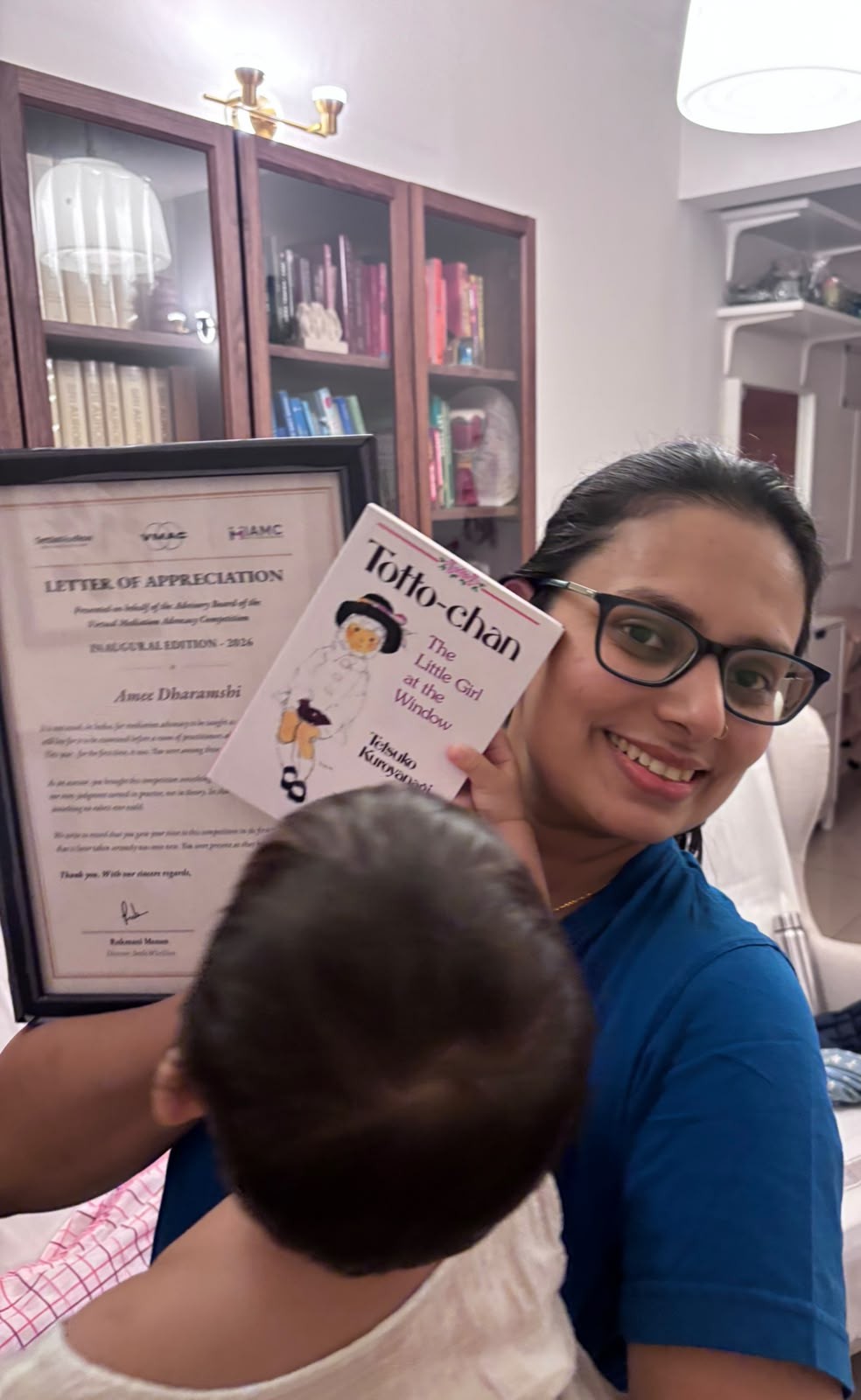
But there was another part of this experience that made it particularly special for me. I have received a package containing a certificate and a book as a thank-you!


Now, have you ever come across a mediation competition organiser, university, college or group that has gifted a book as a thank-you? I haven’t come across many! I have, however, met the team at PACT, who gifted me their book Mediation Simplified at their first Mediation Championship India (MCI).
This time, the book gift has become a little family celebration. More than me, my two humans at home — one at 34 years and the other at 8 months — have been super excited about receiving a book as a gift!
Harsh has already begun reading it to our baby Ahana. And I get to hear the story unfolding in the background while folding baby laundry.
Of course. 🙂
It’s all so lovely, in a package! And perhaps that’s what made this opportunity possible in the first place. Rukmani thought about how I could contribute while caring for an infant. Harsh jumped in and said, “Go for it! I’ll keep baby Ahana with me!”
And the SWN team understood that participating in a 3.5-hour-long competition with an 8-month-old baby meant that I might need a small window to switch off my video and breastfeed my baby. That flexibility meant I didn’t have to worry about what would happen if baby Ahana needed me urgently. I could participate while knowing that my needs as a breastfeeding mother were understood and accommodated.
A big thank you to the SWN team, especially Anubhab and Aanchal, among others who directly coordinated with me and made the arrangements work.
And none of this would have happened without all these little acts of consideration. Perhaps that’s what stayed with me the most. This wasn’t just about finding a way for me to participate in a mediation competition. It was about people being willing to make a little room.
Room for the mediator.
Room for the mother.
Room for the person who happens to be both at the same time.
VMAC brought together all these parts of my life — the mediator, the assessor, the learner, the mother, and the woman who still loves being surprised by a book in the mail.
And it reminded me that sometimes, what makes participation possible isn’t one person doing something extraordinary.
It’s a village of people who make room.
Grateful for the opportunity at VMAC, the challenge, the book, and the village that made it all happen. 🙂
And, dear reader… Thank you for reading :), this post.


Leave a Reply